Data powers advertising, media, social platforms and the models now learning from them, yet moving raw files grows harder every year. Inventor Vatsal Soin’s filed 0→1 Doctrine is designed to let brands reach the right needs through checked ranges, pre-execution, with consent first. Band-Based Archive Triage (BBAT), filed separately, is designed to let holders earn from stored data while the files stay home.
ONE LANGUAGE FOR VALUE WITHOUT EXPOSURE
Data speaks in endless units: clicks, minutes watched, kilometres run, shopping baskets, ages, postcodes and, for AI, probabilities. Each is an island, and the usual way to cross between them has been to move the raw file. The 0→1 Doctrine is designed as a shared number language: each measure sits on its own 0 to 1 scale, keeping its meaning, units and limits, so value can travel as a checked range instead. Both inventions are domain-agnostic; the data economy is one small window on their reach. |
DATA’S VALUE IS RISING, AND SO IS ITS WEIGHT
Data powers the world’s advertising, media and social platforms, and now the training of AI. Its value keeps rising, and so does the cost of moving it. Consent rules are tightening, deletion requests are growing, and AI agents are starting to act for people who want their data kept home. Many holders sit on archives they cannot safely open or sell. Trust, more than volume, is becoming the scarce asset.
THE NEXT MODEL: SIGNALS, NOT FILES
The patents filed by inventor Vatsal Soin point to a different model. What travels is a governed signal: a range, a category notice or a training signal, each with a receipt. What stays is the file and the identity behind it. Holders can keep earning, buyers get what they need, and the raw data stays where it is held.
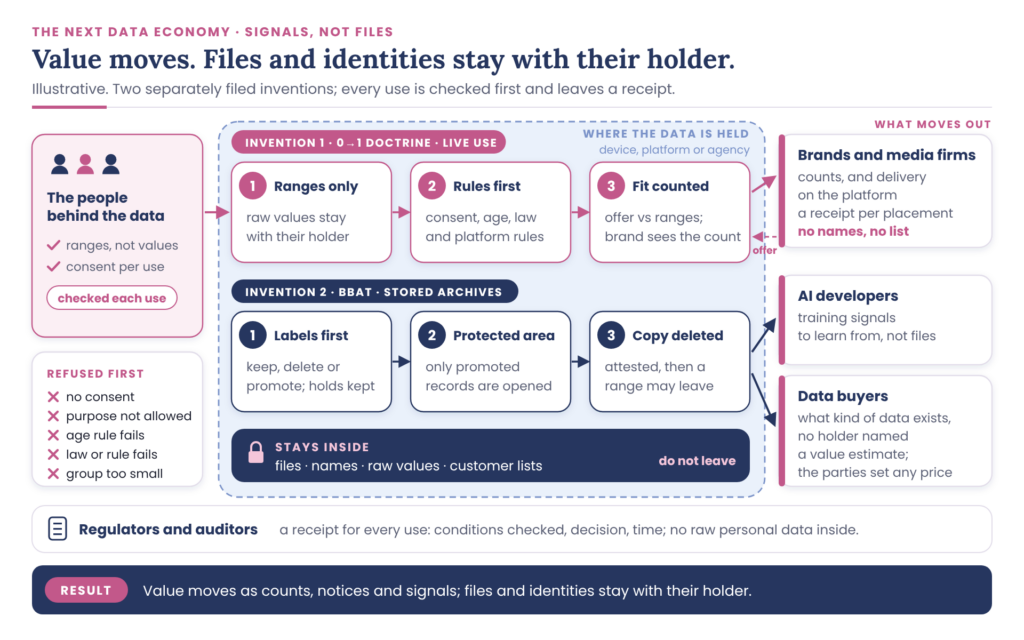
Figure 1. Two inventions: live use checked before delivery, stored archives sorted first; files stay with their holder.
REACHING THE RIGHT NEED
Under the 0→1 Doctrine, a person’s preferences are read as User System Parameters (USP) on their own device or platform and held as ranges in a User Compliance Code (UCC), with slight noise to reduce what any one value reveals, then passed on as a Product Design Token (PDT). A brand’s offer becomes ranges in an Asset Capability Token (ACT). Through Reverse Discovery, the brand learns how many people’s ranges fit, not who they are.
CONSENT FIRST, THEN DELIVERY
Must-pass checks come first: consent for this use, age rules, applicable law and the platform’s own policies. Groups below a set size are refused, so individuals are harder to single out. The Manufacturing Authorization Token (MAT), the authorisation step, lets a delivery proceed, holds it or declines it, and an Actuation Compliance Receipt (ACR) records the conditions checked.
For brands and agencies: the right audience, with each placement explained.
ONE CAMPAIGN, CHECKED
Illustrative example: a sportswear brand wants to reach people training for marathons in one region. The platform reports that 12,400 consenting users’ ranges fit; a smaller sub-group, below the set size, is refused. The campaign runs on the platform, no list leaves it, and the receipt records the conditions. The Fair and Transparent Waste Estimator (FTWE) is designed to estimate spend saved on messages that would have reached no matching need.
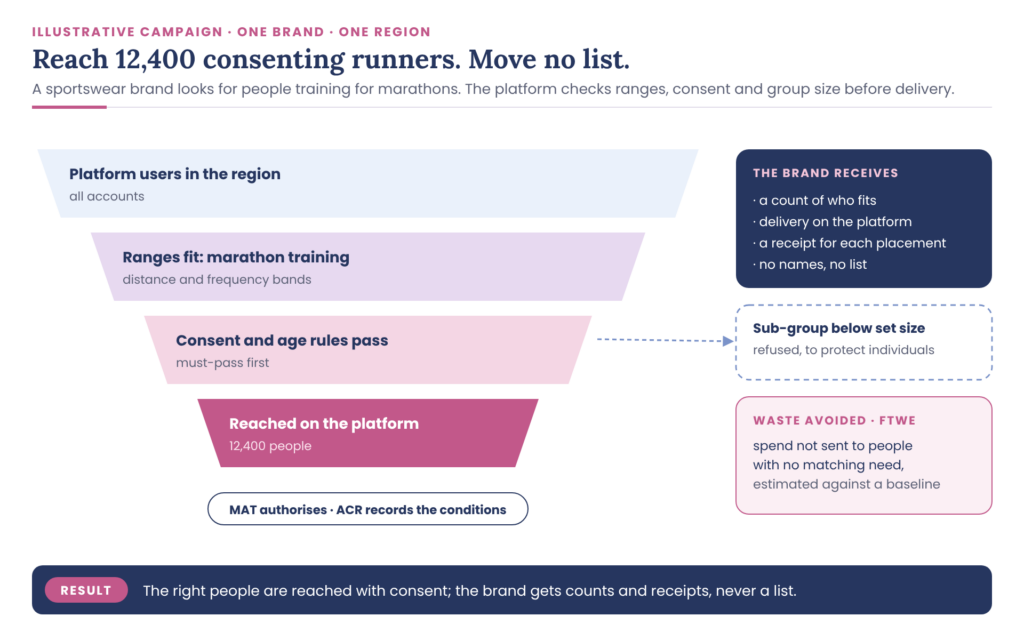
Figure 2. Illustrative numbers: a campaign reaches 12,400 consenting people by range; no list leaves the platform.
STORED DATA: THE SECOND INVENTION
BBAT governs what platforms, agencies and publishers have stored for years. It first sorts each record by its labels alone, such as age, consent, purpose and legal hold, and marks it keep, delete or promote; nothing under legal hold is deleted while the hold lasts. Only promoted records are opened, inside a Trusted Execution Environment (TEE), a protected chip area, and a range leaves only after a Hardware Attestation Certificate (HAC) attests, within the scope it verifies, that the records used were deleted under Delete-Before-Share.
FROM DORMANT ARCHIVE TO VALUE
Dark Data Monetisation Without Exposure (DDME) releases a bounded range derived from promoted data, never a record; any price or deal is set by the parties. A Systemic Category-level Availability Notice (SCAN) tells authorised buyers what kind of data exists, without naming a holder or a record. Band-Derived Training Signals (BDTS) give AI developers governed signals to learn from, instead of files.
For holders: potential income from archives once too risky to touch.
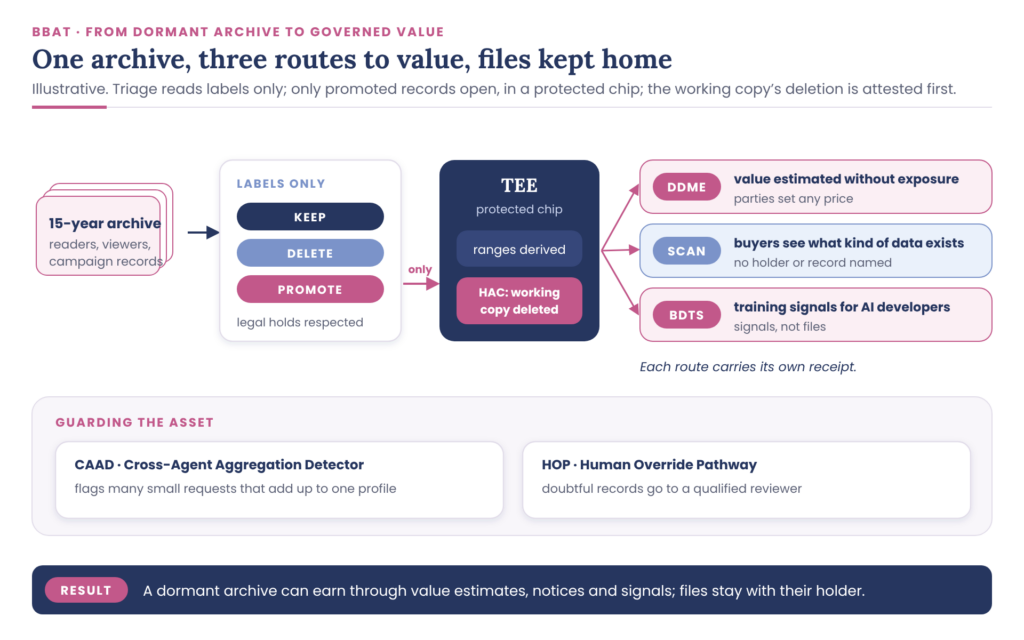
Figure 3. BBAT turns a dormant archive into governed routes to value, each with a receipt, while files stay with their holder.
PROTECTING THE ASSET
A data set can lose its value the moment it leaks. The Cross-Agent Aggregation Detector (CAAD) is designed to flag when many small requests from different agents, each harmless alone, add up to a coordinated pattern beyond set limits, working from sealed receipts alone. Doubtful records go to a qualified reviewer through the Human Override Pathway (HOP).
For holders: value kept, because exposure is avoided.
TRUST THAT CAN GROW CONSENT
People share more readily when they know what leaves and what stays. Here, a person can see that only ranges travel, that groups too small are refused, and that each use leaves a receipt. For platforms, that clarity may widen the pool of people willing to say yes, the base of every data business.
WHAT EACH PARTY GAINS
Platforms and data holders: potential income lines from stored data. Brands and agencies: audiences reached with less waste. AI developers: governed training signals. The people behind the data: preferences used, files kept home. Regulators: a receipt for each use. Investors: a data model designed to keep working as rules tighten.
WHEN AI GROWS SMARTER
Artificial general intelligence (AGI) and artificial superintelligence (ASI) do not exist today. If superintelligent systems one day trade in data at a scale no team can watch, value would still need to move without the files; where these inventions are deployed and enforced, it can.
ONE WINDOW ON A LARGER WHOLE
The data economy is one narrow window on two domain-agnostic inventions, designed for any product, service, asset or archive at any scale. People set the conditions; the inventions check against them and do not judge whether a rule is fair or lawful. Results depend on accurate ranges and labels. Each invention is filed separately and works alone or together.
QUESTIONS DATA LEADERS ASK
01 Does targeted advertising continue?
It continues, reaching ranges with consent rather than lists.
02 Can we still earn from our archive?
That is the aim: ranges licensed, files kept.
03 What does a brand receive?
Counts, delivery and receipts, not identities.
04 Who reads the receipts?
Permitted parties: holder, buyer, auditors and regulators.
CLOSING NOTE
Every age learns to value what it once wasted. In the age of AI, and one day superintelligence, data’s value can move freely, while the lives behind it stay at home.
This can be tested, live, via API, governed against ungoverned, side by side.
THE INVENTOR
Systems theorist, inventor, and serial entrepreneur Vatsal Soin holds grants in the US, Japan, India and more; filings span six continents; latest grant, AI footwear, August 2026. Inventions: footwear, apparel fit, Sharable Size Cards, digital twins, robotics, global governed data, archive triage, quantum-resilient cryptography, AI governance. SIM–RMIT and NTU alumnus. Every prior invention was a step; 0→1 is the destination.
SELECTED REFERENCES
Granted: US Patent 12,446,652 B2 · Japan Patent 7560909 · India Patents 454081 and 599317. Filed: PCT/IN2025/051943 · US 19/489,595 · India 202511115781 · Australia AU2022450649 · India 202611113867 (23 September 2026) · PCT/IN2026/052042 (1 October 2026).
DISCLAIMER
Informational only. Not certified. No endorsement implied. Not investment advice. Examples are illustrative, not field results. Vatsal Soin · © 2026 All Rights Reserved.