Much stored data is never read again, yet it costs money to keep, and organisations are unsure it is safe to delete or share. Band-Based Archive Triage (BBAT), filed September 23 and October 1, 2026, decides from a record’s metadata whether to retain, purge or promote it, and releases a permissioned band with a sealed receipt, designed for quantum-safe seals. The 0→1 Doctrine checks the decisions that follow. Together these Metainventions point toward Authorized Intelligence.
LIVE www.0to1doctrine.com
THE TWO INVENTIONS AT A GLANCE

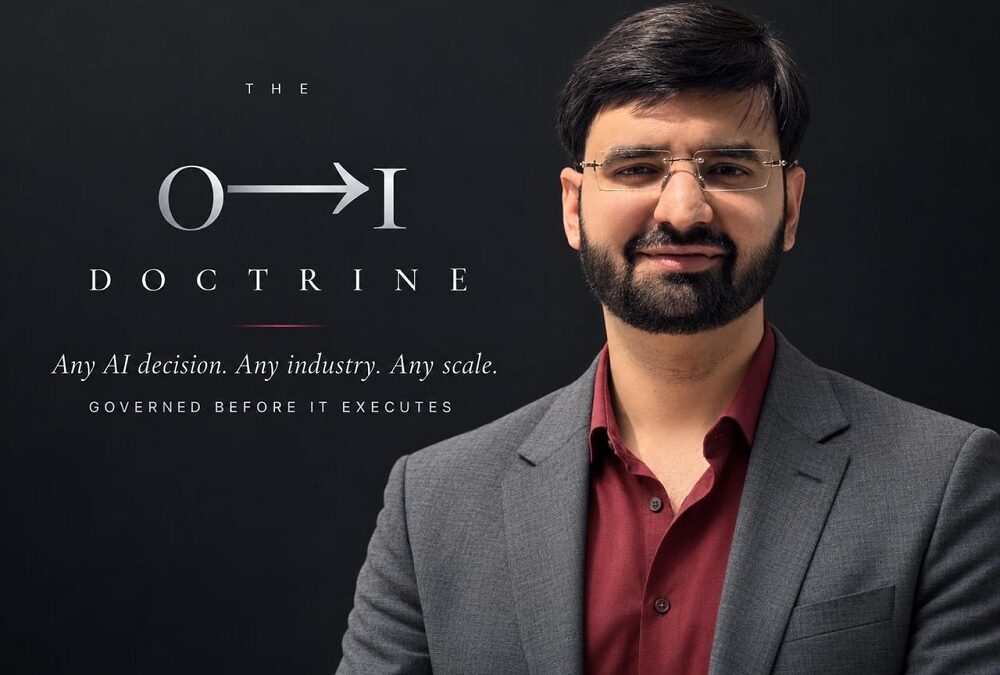
Band-Based Archive Triage, or BBAT, is a filed system for stored records. It sorts each record into keep, delete or promote. A promoted record is processed inside a secure environment to yield a band, a short range of values between 0 and 1. The 0→1 Doctrine, a separate filing, puts human needs and abilities on the same scale and checks each decision against allowed limits.
WHY DATA GETS STUCK
Stuck data is data an organisation holds but cannot use, delete or share. Industry estimates put the share of enterprise data kept but never used at about 80 to 90 percent, and storing it costs money. Three common barriers keep it there: nobody knows what is inside, nobody is sure it can be deleted or shared, and nobody can prove what was done.
WHAT IS IT, AND CAN IT GO?
Opening every file is slow, and each opening is access to private content. BBAT starts from metadata, such as age, category, consent reference, hold flag, jurisdiction and retention policy. These become values on the 0-to-1 scale and combine into one retention score. Triage does not open the stored content. Records that meet no retention condition, such as redundant, obsolete or trivial data (ROT), can be purged under authorisation, with a sealed receipt. A hold or a low-confidence result sends the record to a person. Records worth using are promoted, and that is where sharing begins.
CAN IT BE SHARED, AND PROVED?
A promoted record is processed inside a hardware-isolated environment, where a band is derived. Derivation stops if the group is below a set size, a band narrower than a set width is widened, and release is suppressed if the check finds that linking it with identified outside datasets could identify people. Source records within the declared deletion scope are deleted inside it before release. A hardware-held gate opens only after the checks pass and a sealed receipt exists, and only one band and that receipt leave. Each purge and each promotion leaves a sealed receipt with no record content, so an auditor can check outcomes without seeing the archive.
ONE ARCHIVE, THREE OUTCOMES
Take old service logs. The metadata shows many are past their retention period, with no condition requiring them to stay. A few sit under a legal hold, and the rest are still useful. The first group is purged under receipts, the second waits for a person, and the third is promoted and yields bands. The sorting itself opened no file.
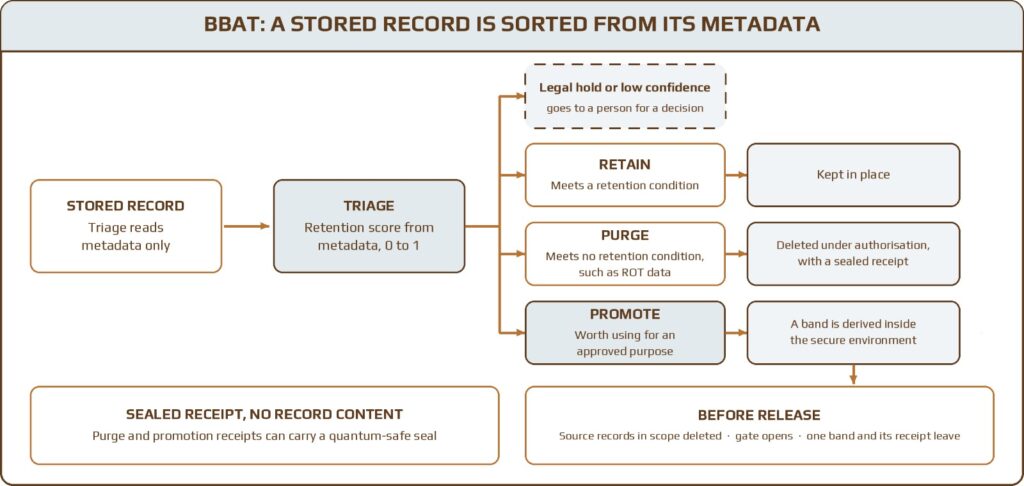
Figure 1. BBAT sorts a stored record from its metadata and releases only a checked band and its receipt.
TWO USES FOR A BAND
Dark Data Monetisation Without Exposure (DDME) releases one bounded interval and no source records. Band-Derived Training Signals (BDTS) pools bands from many sources, accepts no identity attribute, tests each signal for rebuild risk, suppresses any that fail, and packages the rest for AI training.
DDME: ONE BOUNDED INTERVAL
A holder shares one figure about its data, with a sealed receipt, and keeps everything else. For owners and backers of data-heavy businesses, that is the reason to care: an idle archive can become usable with less exposure. DDME sets no price. Any sector with idle records can share one checked figure, for example a demand range from an airline, a retailer or a university, while source records in scope are deleted before release. Stored records then add value.
BDTS: THE DATA WALL AND MODEL COLLAPSE
One published estimate says public human text for AI training could be fully used within the next several years, and training AI on AI-made content can lower its quality, a problem known as model collapse. BDTS offers a governed route to privacy-tested signals from private human-generated data, with a receipt recording batch size range, test result and method. As AI grows more capable, up to superintelligence, a traceable supply can matter more.
SEALS THAT LAST IN A QUANTUM AGE
A future quantum computer, built on qubits, could break many of today’s digital signatures. The filings describe quantum-safe seals, so a receipt sealed today can still be checked later. The scheme can be swapped as standards change.
SEPARATE FILINGS, ONE SCALE
BBAT and the 0→1 Doctrine are separate filings. They share a 0-to-1 scale; BBAT carries its own normalisation engine. An organisation can adopt either one, or both. Used together, a stored record and the action that uses it each leave a receipt.
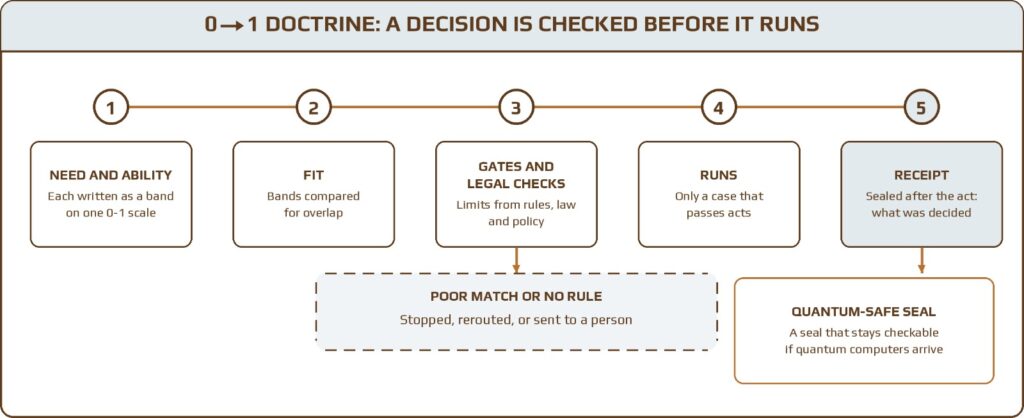
Figure 2. The 0→1 Doctrine checks a decision before it runs; its receipt can carry a quantum-safe seal.
WHERE IT HELPS
- Just to illustrate, a hospital can clear records no rule requires it to keep and show the rule applied.
- A bank can share one checked figure from its history without handing over customer files.
- A telecom operator can cut the cost of storing stale logs.
- A public archive can keep what rules require and give auditors a receipt.
WHY NOW
AI needs more data, and data protection rules limit what can be shared. Both meet in the archive. BBAT is designed to reduce risk and support permitted use, starting from metadata, without moving the archive.
QUICK ANSWERS
Who owns the value?
The data holder keeps all existing rights. BBAT transfers no ownership.
Is the archive deleted?
Not as a whole. Records that meet no retention condition are purged under authorisation. For a promoted record, source records within the declared scope are deleted before release.
Who sets the limits?
Authorised, documented rules: law, regulators, sector bodies, contracts or an organisation’s own policy, which cannot override law.
What is a receipt?
A cryptographically sealed record of what was decided and done, with no source-record content. It does not prove the source metadata was right or that training rights exist.
Is there a demonstration?
Yes, on the website, with governed and ungoverned runs side by side.
CLOSING NOTE
Do not leave data to sleep. Give it a label, a limit and a quantum-resilient seal, and let the archive begin to work.
LIVE www.0to1doctrine.com
This can be tested, live, via API, governed against ungoverned, side by side.
THE INVENTOR
Systems theorist, inventor, and serial entrepreneur Vatsal Soin holds grants in the US, Japan, India and more; filings span six continents; latest grant, AI footwear, August 2026. Inventions: footwear, apparel fit, Sharable Size Cards, digital twins, robotics, global governed data, archive triage, quantum-resilient cryptography, AI governance. SIM–RMIT and NTU alumnus. Every prior invention was a step; 0→1 is the destination.
SELECTED REFERENCES
Granted: US Patent 12,446,652 B2 · Japan Patent 7560909 · India Patents 454081 and 599317. Filed: PCT/IN2025/051943 · US 19/489,595 · India 202511115781 · Australia AU2022450649 · India 202611113867 (23 September 2026) · PCT/IN2026/052042 (1 October 2026).
DISCLAIMER
Informational only. Not certified. No endorsement implied. Not investment advice. Examples are illustrative, not field results. Vatsal Soin · © 2026 All Rights Reserved.