Hyderabad, 17 September 2026: The CII-GEC Cleantech Nexus 2026, organised by the Confederation of Indian Industry (CII), brought together industry leaders, investors, start-ups, technology innovators, research institutions and ecosystem stakeholders to strengthen pathways for the commercialisation and scale-up of cleantech solutions. Held at HICC, Hyderabad, the inaugural edition was themed “Enabling Cleantech Ecosystem Collaboration & Accelerating Sustainable Innovation” and carried the message “Innovate | Collaborate | Validate | Accelerate.” The session focused on building stronger connections between innovation, industry and capital and setting the context for scaling sustainable technologies.
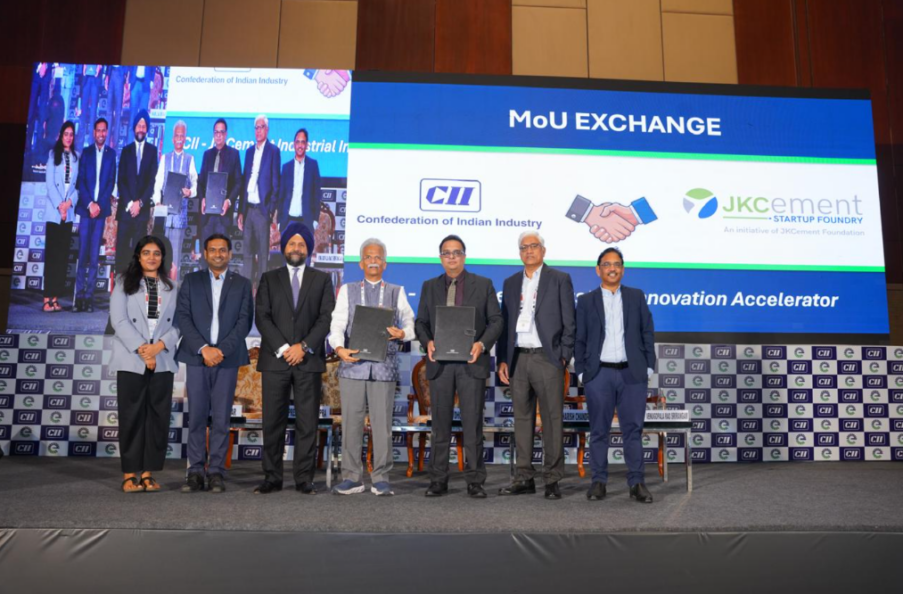
A key highlight was the MoU exchange between the CII–Green Entrepreneurship Council (GEC) and JKCement Startup Foundry to collaborate on the CII-JK Cement Industrial Innovation Program, a problem-statement-based open innovation challenge aimed at identifying and engaging start-ups and technology providers to address JK Cement’s priority challenges across operational efficiency, sustainability, digitalisation and decarbonisation. As part of the programme, CII-GEC will support the identification of challenge areas, scout and evaluate relevant solutions, facilitate industry–startup interactions, and support the development of a pipeline of pilot-ready technologies for validation and potential deployment across industrial operations.
Speaking on the importance of building a connected cleantech ecosystem, Mr. Pradeep Dhobale, Chairman, CII-GEC Council, said, “A great technology does not automatically become a great business. And a great startup does not scale at an isolation. An entrepreneur has technology, but they have need, but they need an industrial partner. Industrial companies have markets, but they need technology. And investors may have the capital but may need confidence about scalability of the business. The startups have great products, which need access to customers, pilots, manufacturing, or regulatory support. So, the missing ingredient is often not innovation; it is collaboration.”

Mr. Tejpreet Singh Chopra, Chairman, Energy Efficiency Summit 2026 and Founder & CEO, BLP-Industry.AI, said, “India has a massive opportunity to bring AI to the factory floor—especially for 74 million MSMEs that often don’t have the capital for expensive cloud and GPU usage. As compute costs rise, we need solutions that are affordable, secure, and practical. One approach is deploying trained models on edge systems inside the factory, ensuring the data stays local, while also addressing sovereignty or privacy concerns. With a one-time investment, factories can run predictive models for failures and efficiency without ongoing GPU costs. This is where India can innovate differently, and at scale.”
Mr. Venugopala Rao Srirangam, Associate Vice President, My Home Constructions and Mr. Harish Chandra Prasad, Past Chairman, CII Andhra Pradesh and Chairman, Malaxmi Group and Co-Founder, Dharmavana Nature Ark were also present during the inaugural session and highlighted the importance of industry-led innovation and stronger collaboration with start-ups and technology providers to accelerate the adoption of sustainable solutions.
The program saw participation from 100+ stakeholders, including cleantech startups, incubators, accelerators, investors, industry representatives, technology providers, research institutions and other ecosystem partners. The sessions focused on the key enablers for taking cleantech solutions from innovation to commercial scale, covering access to finance, industry-start-up collaboration, technology validation, market access, industrial adoption and business growth. The program also featured showcases of emerging technologies across sustainable technologies, energy storage, circular economy, water management, resource efficiency and decarbonisation, providing innovators with opportunities to connect with industry, investors and ecosystem partners and explore pathways for pilots, deployment and scale-up.