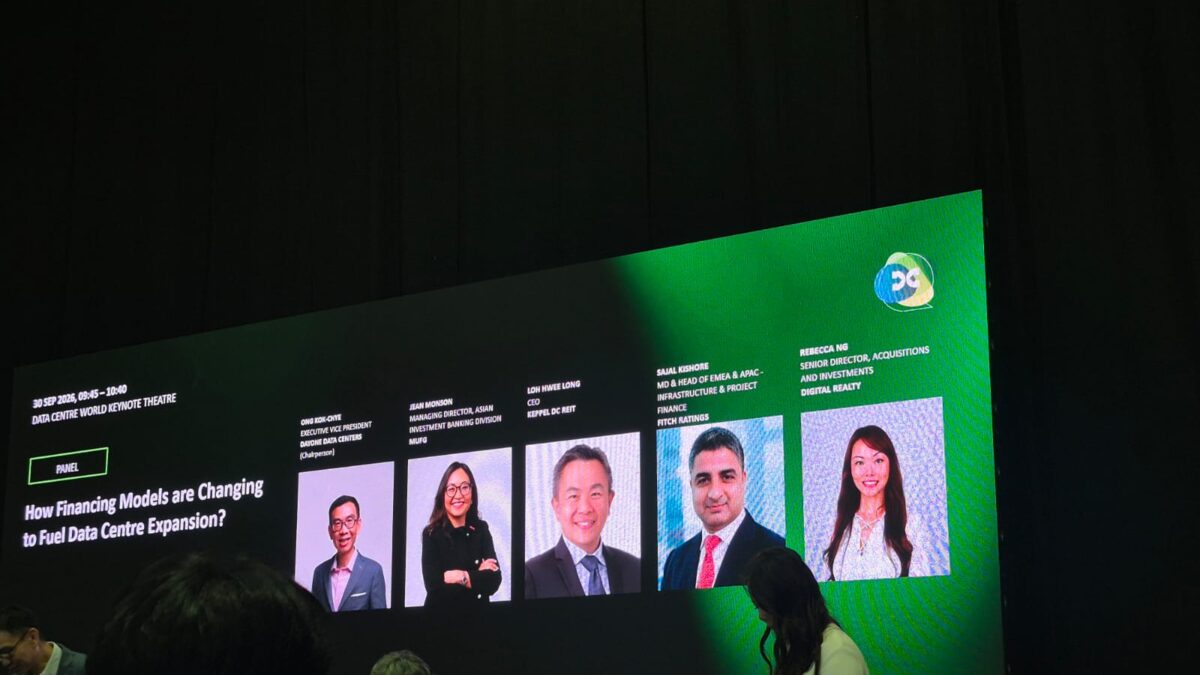
Singapore, 30 September 2026 — While artificial intelligence, power availability and advanced cooling technologies dominate conversations around the future of digital infrastructure, one of the most important discussions at Data Centre World Asia, part of Tech Week Singapore 2026, focused on a less visible but equally critical subject: capital.
The panel, “How Financing Models are Changing to Fuel Data Centre Expansion?”, brought together industry leaders including Ong Kok Chye, Executive Vice President of DayOne Data Centers; Jean Monson, Managing Director, Asian Investment Banking Division at MUFG; Loh Hwee Long, CEO of Keppel DC REIT; Sajal Kishore, MD & Head of EMEA & APAC Infrastructure & Project Finance at Fitch Ratings; and Rebecca Ng, Senior Director, Acquisitions & Investments at Digital Realty.
A clear message emerged from the discussion: the data centre industry has entered a new phase where access to capital is becoming as important as access to land, power and customers.

Across Asia-Pacific, demand for digital infrastructure continues to accelerate, driven by AI adoption, cloud computing, digital transformation initiatives and growing enterprise workloads. As projects become larger and more capital-intensive, financing structures are evolving rapidly to keep pace.
Historically, many data centre developments in the region relied heavily on traditional bank financing. Today, the capital stack is becoming significantly more diverse. Infrastructure funds, sovereign wealth funds, pension investors, REITs, private credit providers and strategic partners are increasingly participating in the sector. New investment structures, platform-level investments and joint ventures are becoming common as operators seek greater flexibility to fund large-scale expansion.
One of the most notable shifts is the growing focus on long-term revenue visibility. Investors and lenders are increasingly evaluating data centre projects based on the strength of customer contracts, tenant quality and the predictability of cash flows. The industry is witnessing more discussions around longer-duration commitments from hyperscalers and major cloud providers, providing greater confidence to financing partners and enabling access to lower-cost capital.
Unlike many technology sectors where product cycles can introduce uncertainty, hyperscalers provide a unique level of stability. The world’s largest cloud companies continue to invest heavily in upgrading servers, networking infrastructure and AI capabilities within their facilities. Their long-term commitment to capacity expansion significantly reduces concerns around technology obsolescence and strengthens the underlying investment case. As several panellists observed, financiers are increasingly underwriting the strength of customer relationships and contracted revenues rather than trying to predict future technology winners.
The conversation also highlighted how the industry’s risk profile is changing. While demand for capacity remains robust, investors are paying closer attention to power availability, supply chains, permitting timelines, regulatory developments and semiconductor supply dynamics. As AI infrastructure scales, access to advanced chips, energy resources and grid capacity has become a critical factor influencing project economics and financing decisions.
What is becoming increasingly evident is that data centres are no longer viewed solely as technology facilities. They are being recognised as critical infrastructure underpinning digital economies, AI ecosystems and national competitiveness. This shift is attracting larger pools of institutional capital that traditionally focused on transport, utilities and energy assets.
For Asia-Pacific, where demand growth continues to outpace available capacity, financing innovation may prove to be one of the defining factors shaping the industry’s next decade. As projects scale from tens to hundreds of megawatts and investment requirements reach unprecedented levels, the ability to structure capital efficiently will increasingly determine which developers can capture the opportunities created by AI and cloud-driven growth.
The discussion at Data Centre World Asia underscored a simple reality: the future of data centre expansion will not be driven by technology alone. It will be driven by the industry’s ability to attract, structure and deploy capital at a scale that matches the ambitions of the digital economy.
Data Centre World Asia is part of Tech Week Singapore. The keynote theatre was powered by Kirloskar Oil Engines.