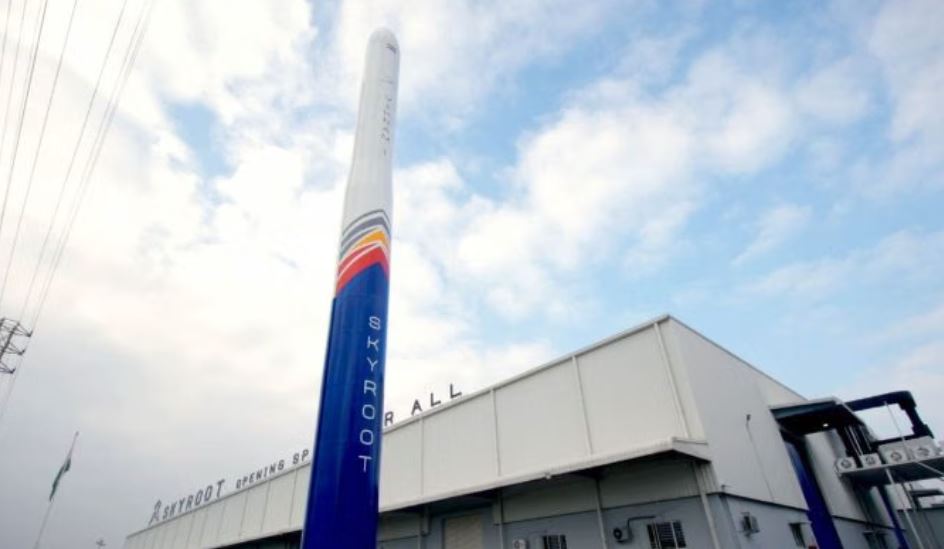
On July 20, 2026, India witnessed a defining moment in its space mission. Skyroot Aerospace successfully launched Vikram-1, India’s first privately developed orbital-class rocket, from Sriharikota.
The achievement marks far more than a successful rocket launch—it signals the arrival of a new era where Indian innovation, entrepreneurship, and scientific excellence are taking center stage in the global space economy.
For decades, India’s space story was written through the extraordinary achievements of ISRO. Today, that story has expanded. Vikram-1 demonstrates that India’s private sector is now capable of building, testing, and launching sophisticated orbital launch vehicles, placing the nation among a select group of countries with private orbital launch capabilities.
Skyroot Aerospace, founded by former ISRO engineers, has shown what becomes possible when scientific talent meets entrepreneurial ambition. The successful “Mission Aagaman” carried multiple payloads and validated technologies developed entirely within India’s growing private space ecosystem. The rocket itself incorporates advanced engineering, including carbon-composite structures, in-house propulsion systems, and 3D-printed engine technologies.
The Power of Indian Scientific Talent
In various broadcast interviews following the launch, Skyroot CEO and Co-founder Pawan Kumar Chandana, along with the Skyroot leadership team, demonstrated the confidence, clarity, and engineering excellence that define India’s new generation of innovators. Their journey reflects a broader truth: Indian scientists, engineers, researchers, and entrepreneurs continue to prove that world-class innovation can emerge from India and compete on a global scale.
India’s civilizational history has always been rooted in knowledge creation—from mathematics and astronomy to philosophy and engineering. The modern innovation economy is, in many ways, a continuation of that legacy. The launch of Vikram-1 reminds us that the spirit of discovery remains deeply embedded in the Indian psyche.
From Cost Advantage to Innovation Leadership
For years, India was recognized primarily for cost-efficient engineering. The world is now beginning to recognize India for something much bigger: deep technology leadership.
Artificial Intelligence, quantum technologies, semiconductor design, cybersecurity, biotechnology, space technology, advanced manufacturing, and climate innovation are rapidly becoming pillars of India’s future economy. Vikram-1 is a powerful symbol of this transition.
The successful mission demonstrates that India is no longer merely participating in global technology markets—it is helping shape them.
The Space Economy Opportunity
The global space economy is projected to become one of the largest growth sectors of the coming decades. As governments, enterprises, universities, and startups increasingly rely on satellites and space-based services, demand for reliable and affordable launch systems will continue to grow. The successful orbital launch opens doors not only for the company but for an entire generation of Indian space startups, suppliers, researchers, investors, and manufacturers.
The Rise of an Innovation Nation
As the global economic order evolves, nations that can create intellectual property, build advanced technologies, and attract talent will lead the next wave of prosperity. India possesses all the ingredients required for such leadership:
– A young and ambitious population.
– A thriving startup ecosystem.
– World-class engineers and scientists.
– Strong digital infrastructure.
– Growing investment in research and development.
– Increasing participation of private enterprise in strategic sectors.
The success of Vikram-1 is evidence that these forces are converging.
The next breakthrough in AI, quantum computing, biotechnology, climate science, cybersecurity, or space exploration may emerge from a laboratory, university, startup, or research center somewhere in India.
Jai Hind !!