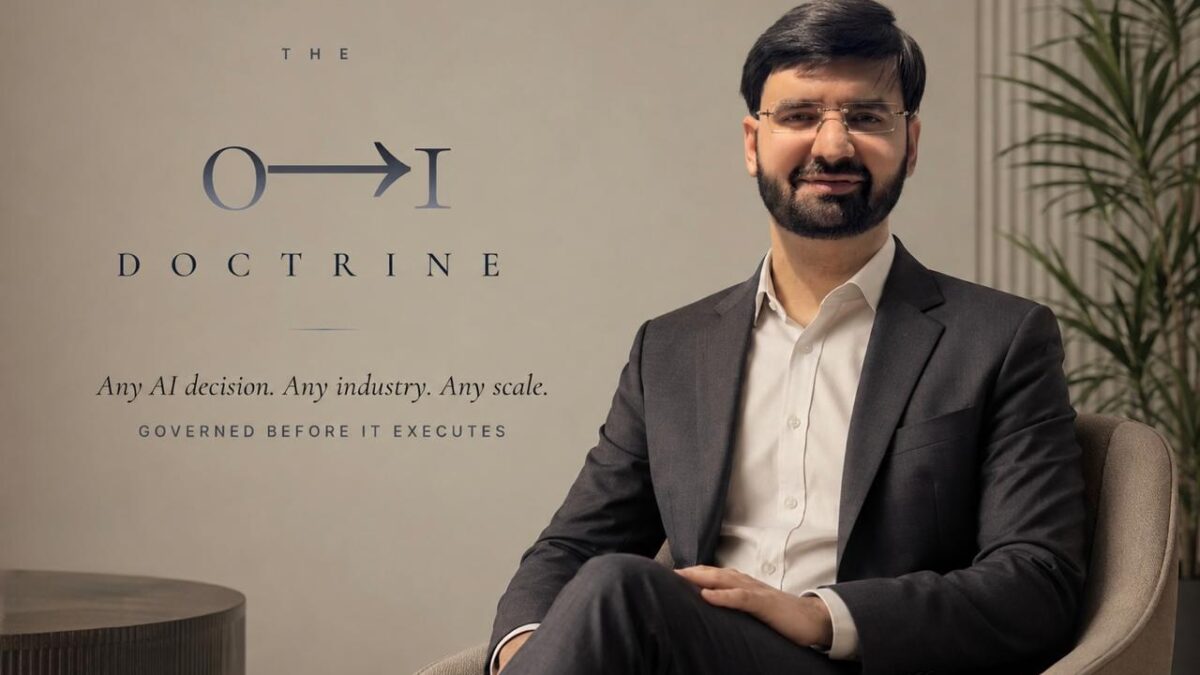
Singularity remains unresolved, but capital cannot wait for an answer. 0 and 1 are the endpoints of a normalized governance range. This is Authorized Intelligence: a pre-execution check testing a proposed parameter against a defined boundary before it becomes action, regardless of which engine — classical or quantum-assisted — produced the proposal.
Live: www.0to1doctrine.com
This invention is a checkpoint. Every field can speak its own language — physics in joules, medicine in enzyme levels, AI in probabilities. A quantum-assisted credit model could flag an application as low-risk; a classical model, checking the same application, could read it differently.

Nothing is necessarily wrong with either result. The problem is that the underlying measures may not share a common decision framework. Defined normalizable parameters can instead be converted into a shared 0-to-1 representation, making relevant differences visible before a consequential decision. This invention creates that common governance layer.
WHY THIS KEEPS HAPPENING
Every control built for one engine inherits the blind spot of never having questioned what a different engine’s numbers actually mean.
Most governance tooling was built to test classical outputs against classical thresholds. It was never built to ask whether a quantum-derived confidence interval, an amplitude-based estimate, or a hybrid pipeline’s result means the same thing the threshold assumes it means.
A qubit is not a classical bit behaving like a tiny 0 and 1 — quantum computation uses states and amplitudes; measurement produces a classical outcome, but not necessarily one calibrated the way a classical system expects.
A GATE THAT DOES NOT CARE WHICH ENGINE PRODUCED THE NUMBER
The check was never on the computation. It was always on the proposed consequence.
The 0→1 Doctrine uses 0 and 1 differently from either classical bits or qubits: as endpoints of a normalization range testing a proposed action against a defined boundary, with HOLD as the human-authority route when the number cannot be trusted on its own terms.
Every governed proposal splits into two zones. Zone One is how a system thinks — never inspected, whether the system is classical software, an agentic model, or quantum-assisted. Zone Two is what becomes real: a Service-Product Fit Score compares the proposal against what a capability band can actually deliver, the same evaluation regardless of which engine generated it.
FIRST EXAMPLE, WORKED THROUGH
A single mismatch, caught before it reached a bank account.
A classical software proposal normalizes to [0.74, 0.80] against an authorized band of [0.70, 0.85] — inside range, passes the compatibility test, authorization remains subject to the gate. No incident. No headline.
SECOND EXAMPLE, WHERE THE ENGINES DISAGREE
Trust does not transfer between engines just because both produced a number that looked confident.
The same proposal type, run through an AI agent, normalizes to [0.88, 0.94] against the identical [0.70, 0.85] band — outside range. It routes to Reject, not Hold, because the gap is real. The agent’s own confidence in the number does not inherit authority just because a classical system nearby had passed a similar-looking check earlier that day.
THIRD EXAMPLE, WHERE THE MISMATCH HIDES IN PLAIN SIGHT
The anomaly was never in the number. It was in how confidently the number was reported.
A quantum-assisted version of the same proposal normalizes to [0.81, 0.86], overlapping only the edge of [0.70, 0.85]. Taken alone, the figure looks unremarkable. But a confidence-sensitivity condition, reflecting that the two engines may not express confidence the same way, routes it to HOLD rather than automatic authorization — a human decides, not a machine’s best guess dressed up as certainty.
The internal processes of all three are radically different. The sequence does not change: Proposal, Normalize, Band, Fit Evidence, Authorize or Reject or Hold, Receipt.
A GRID DOES NOT WAIT FOR CONSENSUS EITHER
No single adjustment looked risky. The pattern across all of them was the actual signal.
Many autonomous grid-balancing agents each propose a micro-adjustment to load distribution within their own authorized band. The governance layer evaluates every proposed adjustment independently at the moment of actuation — the identical gate mechanism above, now applied to physical infrastructure, showing how the mechanism can be applied across domain types, not only across capability level.
EVEN ONE SENSOR READING CAN CARRY VERIFIED EVIDENCE
The same discipline applies below a full decision. A structural-load sensor reporting a single measurement is admitted only if the reading carries a source-level attestation co-signed at the point of measurement — whether it feeds classical hardware or a quantum-assisted analysis downstream.
THE IDENTITY PROBLEM THIS ALSO ANSWERS
The check runs on what was proposed, never on whichever engine claims credit for proposing it.
Most institutions cannot yet reliably distinguish which engine produced a given number — whether a recommendation originated from classical software, an AI agent, or a quantum-assisted process feeding into the same pipeline. A gate bound to the proposed action itself, not to whichever engine claims credit for producing it, closes that gap structurally rather than procedurally.
EXPLAINABLE BY DESIGN, NOT BY RECONSTRUCTION
When a regulator or an investment committee asks why a proposal was authorized, rejected, or held, a filed explainability layer generates a human-readable account of exactly how the value was normalized, compared, and decided — the actual computation sealed at the time, never a plausible reconstruction assembled afterward to sound convincing.
WHY THIS MATTERS TO CAPITAL BUILDING THE NEXT DECADE
The winners of this decade will not be whoever computes fastest, but whoever can prove what the computation actually authorized.
Capital is already flowing into quantum-adjacent infrastructure faster than governance is maturing behind it. An architecture treating every engine’s output through one honest gate is not a compliance feature.
It is the difference between an institution trusted with heterogeneous infrastructure, and one needing a separate governance system for every new engine it adds.
WHAT THIS DOES NOT CLAIM
It does not claim quantum computers currently require this architecture, that quantum computing creates superintelligence, or that the Doctrine is itself a quantum algorithm. The parallel is conceptual; the mathematics remain different.
WHY THIS CANNOT STAY OPTIONAL
The absence of a discovered mismatch this quarter is not evidence the exposure isn’t there.
Any institution running quantum-assisted systems alongside classical AI — a number that is growing, though still small — inherits this same exposure, whether or not a mismatch has surfaced yet.
“A single miscalibrated number can compromise a whole portfolio of allocations. Singularity or not, capital needs Authorized Intelligence now: one gate every engine, classical or quantum, must answer to before it ever becomes a position”
Live: www.0to1doctrine.com
This can be tested, live, via API, governed against ungoverned, side by side.
THE INVENTOR
Vatsal Soin is a serial inventor and entrepreneur with patent filings across six continents and grants in the US, India, Japan and South Africa. He is a SIM–RMIT alumnus and an alumnus of Nanyang Technological University, Singapore. His latest grant, dated August 14, 2026, introduces an AI-powered footwear system and Global Sharable Size Card invention.
SELECTED REFERENCES
Granted: US Patent 12,446,652 B2 · Japan Patent 7560909 · India Patents 454081 and 599317 · Filed: PCT/IN2025/051943 · US 19/489,595 · India 202511115781 · Australia AU2022450649
DISCLAIMER
Informational only. Not certified. No endorsement implied. Not investment advice. Examples are illustrative, not field results. Vatsal Soin · © 2026 All Rights Reserved.