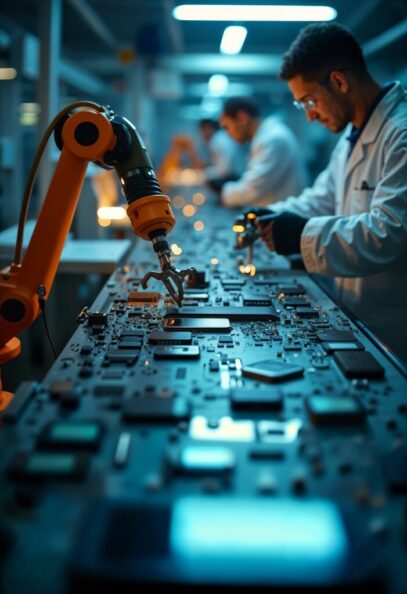
The Union Budget 2026 has set India on a path to becoming a global leader in semiconductor and electronics manufacturing. The launch of India Semiconductor Mission 2.0 focuses on creating a full-stack Indian IP ecosystem, reducing import reliance and building a resilient, self-sustaining supply chain. Empowering these initiatives with technologies like AI, machine learning, and automation will optimize production processes, enhance scalability, and ensure global competitiveness. This move positions India as a hotspot for electronics manufacturing, fueling technological advancements and digital transformation. AI-driven manufacturing will boost efficiency, resilience, and skill development, enabling India to lead in 5G, IoT, and next-gen technologies and attract global investments.
India Semiconductor Mission 2.0
India Semiconductor Mission 2.0 is a key component of this vision, shifting the focus from basic assembly to the creation of full-stack Indian intellectual property (IP). This strategic move reduces India’s reliance on foreign imports and empowers domestic companies to innovate, create, and compete globally. As Mr. Shishir Gupta, Co-founder & CEO of Oakter, explains the launch of ISM 2.0 marks a shift to technological depth and IP ownership, opening the door for localized innovation. ₹10,000 crore SME fund will drive localisation through capability, not just volume. These measures create space for India to move beyond contract manufacturing, enabling companies to design, build, and scale complex products domestically. By strengthening supply chains and unlocking automation, India can evolve from being a contract manufacturing hub to a global leader in electronics innovation, competing not just in volume but in value creation.

Electronics Components Manufacturing Scheme
The ₹40,000 crore allocated for the Electronics Components Manufacturing Scheme is a bold step towards strengthening India’s electronics ecosystem. This funding will empower original design manufacturers (ODMs) to scale operations, ensuring a robust infrastructure for producing high-tech components. By fostering a self-sustaining supply chain, India can now design, develop, and manufacture complex electronics within its borders. Madhav Krishna, Founder and CEO, Vahan.ai highlights that this move will be a force for job creation not just through labor-focused policies, but via capacity-building initiatives like the Semiconductor Mission 2.0 and domestic manufacturing. Large-scale job demand will stem from these efforts, especially as supply chains expand into Tier 2 and 3 cities. To meet this demand, skilled workers must be readily available, which is where sector-aligned skilling becomes crucial. Additionally, technology and AI-driven workforce systems can play a pivotal role by forecasting demand, mobilizing labor, and ensuring that industrial growth translates into jobs quickly, enhancing execution and scalability across regions.
In addition to strengthening the semiconductor sector, the Union Budget places a strong emphasis on empowering micro, small, and medium enterprises (MSMEs). The ₹10,000 crore SME Growth Fund will address critical capital gaps, enabling MSMEs to adopt advanced technologies and scale their operations. As Alok Nigam, Managing Director of Brother International (India), states, the announcement of a ₹10,000 crore SME Growth Fund, along with the increased ₹40,000 crore outlay for electronics manufacturing, signals India’s commitment to deepening value addition and building resilient supply chains. These initiatives will drive digital transformation across MSMEs, enabling innovation and competitiveness in the global tech landscape.
Deep-Tech Startups and Hardware Companies
The Union Budget 2026’s focus on building a self-reliant and resilient semiconductor and electronics supply chain has significant implications for deep-tech startups and hardware companies. By nurturing local capabilities in design, materials, and equipment, the mission ensures that India reduces dependency on imports. As Gokul NA, Founder of CynLr, highlights, ISM 2.0 shifts India’s semiconductor strategy from assembly to full-stack IP creation, empowering startups to develop competitive technologies locally. With the ₹40,000 crore allocated for electronics manufacturing, India is poised to become a global leader in advanced technologies like AI, IoT, and automation, fostering innovation that will drive economic growth and attract global investments.
Aerospace and Defense Manufacturing
Venkatesh Mudragalla, Co-founder and COO at Jeh Aerospace believe Union Budget 2026 emphasizes strengthening India’s aerospace and defense manufacturing by fostering high-precision, high-certification sectors that demand advanced engineering, patient capital, and integrated supply chains. The National Manufacturing Mission outlines long-term policy focus on localization, cluster-led scale, and depth in the manufacturing ecosystem critical for sectors where quality, traceability, and reliability are essential. Exempting customs duties on key components, parts for civilian aircraft, and raw materials for defense MRO enhances cost competitiveness. Over time, policy consistency and a robust ecosystem will be pivotal in enhancing India’s global aerospace and defense supply chain presence.
Electric Vehicle Industry
The Union Budget 2026–27 introduces key measures that will significantly support India’s growing electric vehicle (EV) industry. Industry leaders have highlighted the importance of the government’s focus on expanding the Rare Earth Permanent Magnet Scheme and developing dedicated rare earth corridors in mineral-rich states. As Ms. Madhumita Agrawal, Founder & CEO of Oben Electric, points out, these initiatives will reduce import dependence for critical materials needed in EV manufacturing, bolstering the domestic supply chain. Additionally, the India Semiconductor Mission 2.0 and the Electronics Components Manufacturing Scheme are vital steps toward strengthening local semiconductor capabilities and reducing reliance on imports, a sentiment echoed by Mr. Sameer Moidin, Founder & CEO of EVeium Smart Mobility, who also notes the significance of reduced customs duties on lithium-ion battery capital goods for local manufacturing. Mr. Kunal Arya, Co-founder & MD of Zelio E-Mobility, further underscores how these measures, combined with the ₹10,000-crore SME Growth Fund, create a solid foundation for scaling the electric two-wheeler segment and boosting India’s “Make in India” initiative. Together, these measures not only enhance local manufacturing but also pave the way for affordable, reliable electric two-wheelers, supporting both MSMEs and large manufacturers in meeting the growing demand across Tier II and III markets. However, industry experts agree that resolving the inverted GST structure remains a critical next step in ensuring the sector’s full potential.